1. INTRODUCTION
1.1. Types of heat exchangers
SHELL AND TUBES
Below are the operation of a heat exchanger shell and tubes.
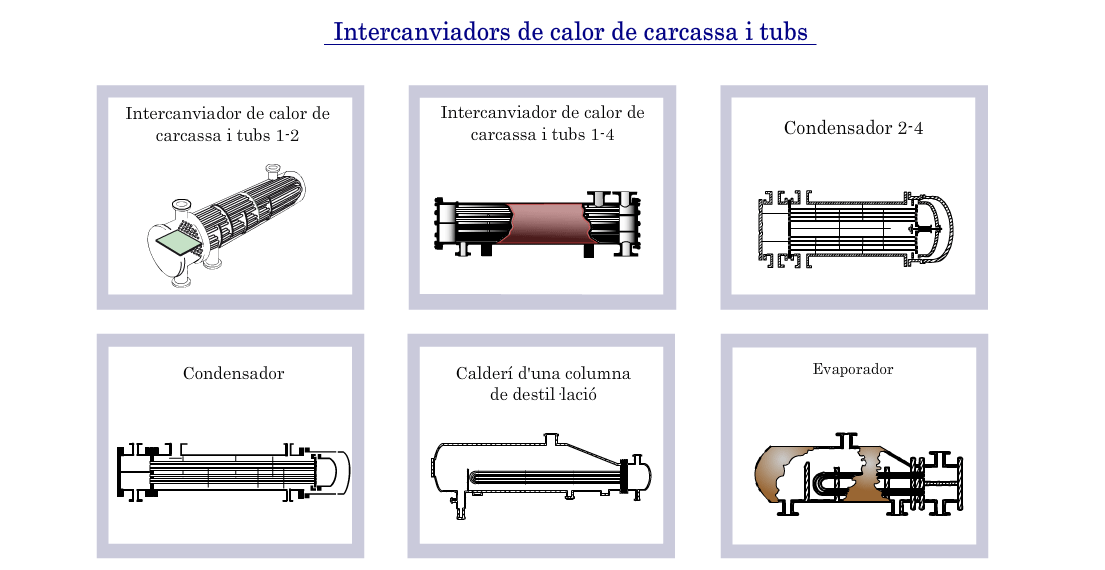
The heat exchanger shell and tubes is the most widely used in industry. It consists of a casing and a multitude of tubes. They are classified by the number of times passing the fluid to the casing and the number of times the fluid passes through pipes.
In the multi-step heat exchangers used an even number of steps in the next step or a tube and the side of the casing.
For example the first heat exchanger that is represented is 1-2, ie the fluid circulates once in the body and what is inside the tube passes twice. The second image is a heat exchanger shell and tubes 1-4, through which the hot fluid inside the tubes 4 times and 1 time for the fluid cooling the body. The third image is a condenser where the steam enters the casing and out of the bottom as a liquid. The cold liquid, which is typically water, enters the bottom inside of the tubes and out the top. Sometimes not all the vapour condenses and to perform a purge air. Finally we see the drum of a distillation column, where there is an evaporation of the solvent from the distillation column that is in liquid form. This is due to evaporation of water vapour flowing inside the tubes, transferring the heat of condensation to the liquid. The liquid evaporates and water vapour condenses. The product exits the bottom of the drum. Is always a mixture of liquid and vapour is returned to the distillation column to separate the components. The latter is an evaporator, the evaporators are described in the section on evaporators.
The tubes that were inside of the casing are placed through a perforated baffle plate, represented as follows:

These plates are placed deflectors to generate a cross flow and induce turbulent mixing in the fluid that was the case, which improves the exchange by convection.
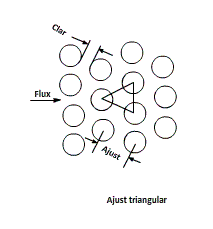
The tubes may have different distributions:
-Adjust block. This configuration allows better cleaning of the tubes. It also makes for less pressure drop on the side of the casing.
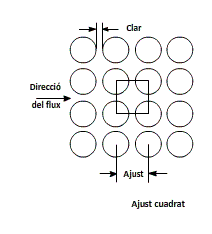
- Adjustment turned square. The advantages of this distribution pipes is the same as above.

- Adjustment triangular. An increased heat transfer surface with square adjustment is not achieved. If the distance from center to center of the tubes is very small, can not be cleaned.