1. INTRODUCTION
1.1. Types of heat exchangers
EVAPORATORS
An evaporator is a heat exchanger shell and tubes. The essential parts are an evaporator heating chamber and the evaporation chamber. The bundle of tubes corresponds to a camera and the frame corresponding to the other chamber. The casing is a cylindrical body inside which is the beam pipe.
The two chambers are separated by the solid surface of the tubes through which heat exchange takes place. The shape and arrangement of these chambers, to ensure that its efficiency is maximum, resulting in different types of evaporators.
We can classify the evaporators into two groups:
- Horizontal Tube Evaporators. The heating steam is saturated steam that gives its heat of condensation and out as liquid water at the same temperature and pressure input. The evaporator tube is called horizontal because the tubes are arranged horizontally.
In the next evaporator, the heating chamber is formed by the horizontal tubes, which are supported by two plates. The steam enters the tubes and condenses to give up its heat of condensation. There can be no condensate steam, which is removed by a purge. The evaporation chamber comprises a vertical cylindrical body, closed bases, the solvent evaporated with an outlet at the top and another outlet for the concentrated solution at the bottom. . These evaporators are usually of iron or steel plate with a diameter of approximately 2 meters and 3 meters high. The diameter of the tubes is usually 2 to 3 inches.
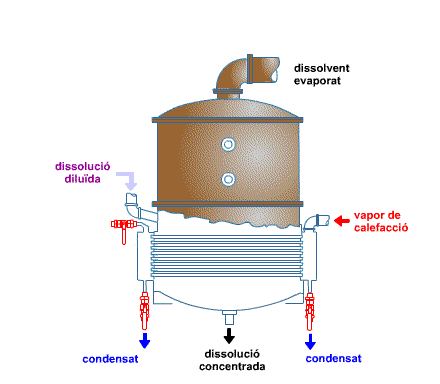
The following evaporator enters the steam inside the tubes, and heat transfer fluid flowing over the tubes, the steam condenses. From the evaporator and the concentrated solution leaves the solvent evaporated.
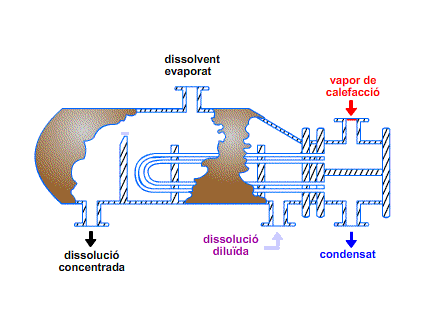
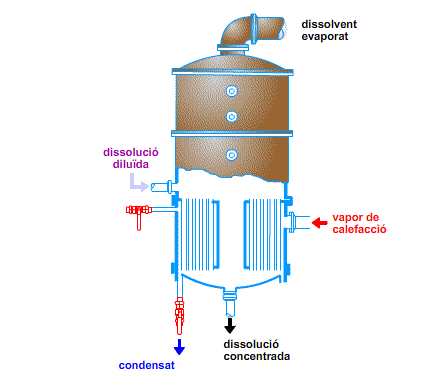
- Vertical Tube Evaporators. Are so called because the tubes are placed vertically within the casing.
The evaporator is located below evaporator is called Standard, which is one of the best known. Evaporation takes place inside the tubes, leaving the top and the solvent evaporated from the bottom of concentrated solution. The steam heater comes on to the beam pipe and exits as condensed water.
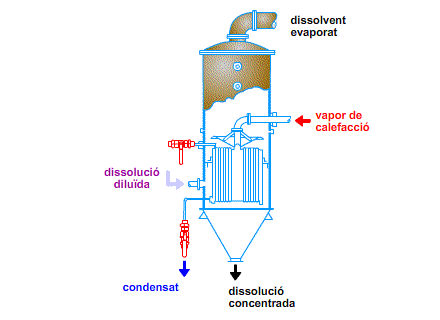
The evaporator basket bellow, which then is another type of vertical tube evaporator, in which the body is conical. This type of evaporator is used when the aim is to bring the evaporation in the end, that is all evaporated the solvent of the solution diluted to obtain crystals. You can also call Crystallisers. The crystals formed are collected at the bottom. The heating element is a compact body that can be removed for cleaning.
Multiple effect evaporator
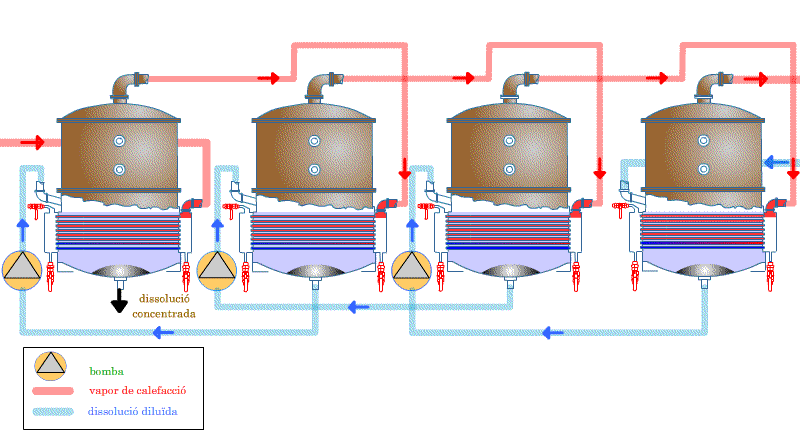
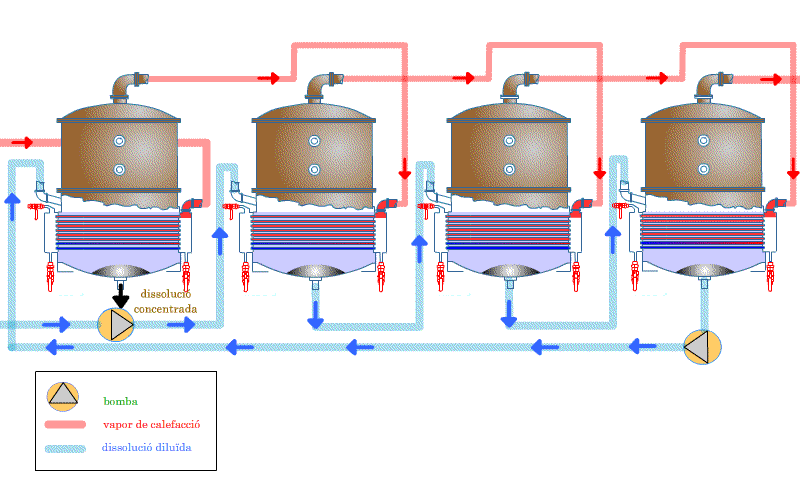
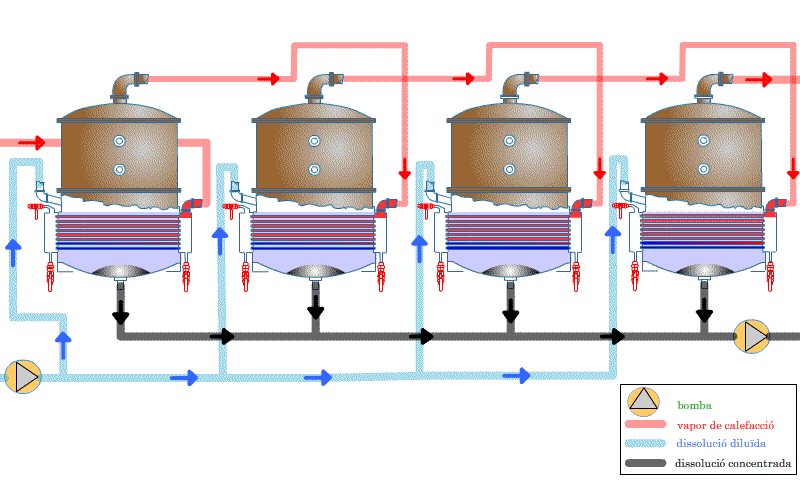
A multiple effect evaporator consists of a series of evaporators, where the first effect evaporator is the first and so on. During the operation, the steam produced in the first effect is used as heating steam in the second effect.
Methods of feed in the multiple effects:
- Feed Direct. The feed enters the first effect and follows the same sense of movement that the steam, leaving the product in the final effect. The liquid circulates in the direction of decreasing pressure and does not need to apply auxiliary power to the liquid pass effect in the other. Only needed two pumps, one for introducing the liquid in the first effect and another to extract the product of the last effect.
- Feed upstream. The liquid evaporates and enters the final effect leaves concentrated on the former. The liquid concentrate and the steam heater circulates in the opposite direction. Here the fluid circulate in the direction of increasing pressures and this requires the use of pumps in each pump to effect the dissolution of a concentrated effect to the next. This represents a considerable mechanical complication that adds to the work done to the pumps at pressures below atmospheric. So, if there are other reasons, we prefer the direct feed system.
- Diet mixed. When a part of the power system is direct and the other party is in opposition. This system is useful if you have very viscous solutions. If we use the pure direct current, we find that the latter effect, where the temperature is lower, the viscosity of the concentrated solution increases, which reduces significantly the overall coefficient, U, for this purpose. To counteract this, use the power to counter or mixed. The diluted solution enters the second effect and follows the direction of feeding directly after passing the final effect of the first to complete evaporation at high temperature.
- Feed in parallel. When feed enters simultaneously for all purposes and meets the liquid concentrate in a single stream. It is a system used in the concentration of common salt solutions, where crystals deposited makes it difficult to provide the feed directly.
In general, we decide for a power system, it is necessary to make a calculation before evaporation performance for each of the systems.
If the input temperature of the food is quite lower than the boiling point in the first effect, in the case of direct currents all the heat that occurs in the first effect is intended to heat the food (heat sensitive) and very little to produce steam, which cause poor performance in the overall process of multiple effects. In this case it is preferred to the circulation counter.
To the contrary, when the solution enters the system at temperatures above the boiling point of the final effect will be more convenient food directly as the solution to enter the final effect on partially vaporize, producing a mist that does not have utilities later, then the solution cool to room temperature evaporation of the last effect and then the warming should go into each end.