4. GENERAL METHODS OF CALCULATION OF HEAT EXCHANGERS
4.2. Method ε-NTU
In this method used the following equations:



With equations 24 and 25 can find the 2 variables necessary in order to find ε graphically.
We can find two types of problems:
- DESIGN PROBLEM
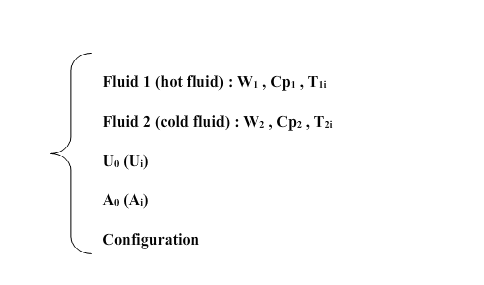
INFORMATION
With this information must be find the area (A0 o Ai).
The steps to follow to find this area are:
1) Proposed the two heat balance equations to find q:
2) Calculate ε and z:
3) With the values found for z and ε, the graph must be found and NTU, as shown schematically in the following graph:
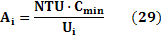
4) Calculate the area (A0 o Ai) from NTU's equation:
Isolated area:
Isolated area:
- HEAT PROBLEM
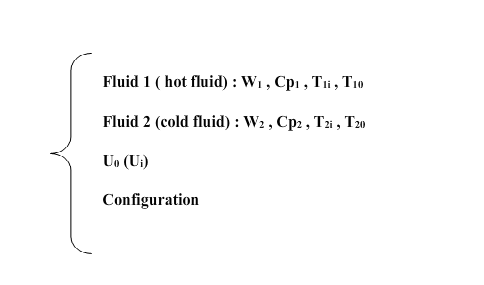
INFORMATION
With this information and using different equations, you have to find the final temperature (T10 and T20).
The steps to follow to find these temperatures are:
1) Calculate Z and NTU:
2) With the values found of Z and NTU, the graph must be found ε, as shown schematically in the following graph:
3) From the value of ε found, calculate the value of heat (q):
4) Proposed the two heat balance equations to find the final temperature (T10 and T20):
If isolated temperature T10:
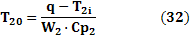
If isolated temperature T20: