


4. EXPERIMENTAL PROCEDURE
4.2. Calibration of pHmetry
This device serves to measure the pH of water. It is important to monitor is pH water to see if this is able to absorb more carbon dioxide or not. Therefore, we extracted a sample of water from the tap to purge the reservoir, previously explained, and put out approximately 100 ml in a beaker or flask. Leave the water a minute and then you should be reading device with basic pH 20.

Figure 4.16: pHmetry Basic 20.
1- Power button.
2- Button ENT, to measure.
3- Button calibration.
The calibration is as follows:
1.Plug the pH.
2.Open the Power button; number 1
3.Click the drawing of the bottle, number 3. Following screen appears:

Figure 4.17: Screen calibration of pHmetry.
4. Put the electrode into a container with the pattern.
5. Must begin by the pattern of pH 7. The patterns are buffer solutions: potassium di-hidrogenfosfat, disodi-hidrogenfosfat and germicide. Both patterns have a different pH from pH 7 and the other is pH 4.1.
6. Press the button to begin reading the bottle calibration.
7. Wait until the device makes reading, following the pattern set pH 4.1.
8. Once the reading is already calibrated.
To read each must follow the following procedure:
1. Open the device.
2. Put the electrode within the container to be analyzed.
3. Press ENT button (2) and wait to finish reading.
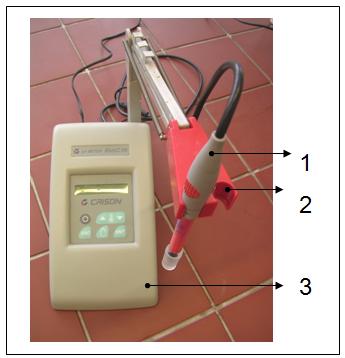
Figure 4.18: pHmetry basic 20.
1- Electrode.
2- Clamps support.
3- pHmetry.