


3. PILOT PLANT ABSORPTION OF GASES
3.1. Main parts of the pilot plant
3.1.3 Panel elements
Below is the panel elements of measure and regulatory, such are located on the computer and description of each, specifying what are features and functions.

Figure 3.8: Panel elements.
1- Bourdon type manometer.
2- Valve adjustment flow of carbon dioxide.
3- Carbon dioxide flow meter.
4- Air flow meter.
5- Air adjustment valve.
6- Thermometer.
7- Flowmeter water.
8- Valve adjustment of water.
9- U-shaped tubular gauges.
Then give each of its component parts:
BOURDON TYPE MANOMETER:

Figure 3.9: Bourdon type manometer.
In the pilot plant, the manometer brand the relative pressure that exists within column absorption, so always we know what pressure we are working. The unit of this parameter is the bar. The only limitation it has is the maximum pressure that can work at the plant, although this manometer can measure up to 2.5 bars, the device can only work up to 1 bar pressure, for security reasons.
VALVE ADJUSTMENT FLOW OF CO2:
The flow meter is a measuring instrument, which serves to measure the flow. They can be found in different sizes and from different units, dependent on being measured. In this case the measure will be of carbon dioxide and its units are l / min.
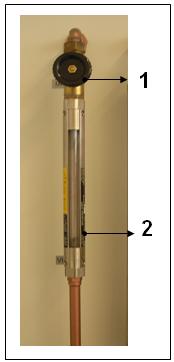
Figure 3.10: Valve adjustment flow of carbon dioxide.
Where:
1- Valve adjustment of CO2.
2- Flow meter of CO2.
This type of flow meter is present in the left pane of elements, as shown in Figure 3.10. This serves to determine how much carbon dioxide are introduced into the column. To regulate this flow is through valve adjustment carbon dioxide. Please note that this was mixed with air, so that also regulate the flow of CO2. As soon as it is moves the flow of air also instantly change the flow of CO2.
Their characteristics are as follows:
- ABB Model D10A11.
- Units of measurement are: s/min.
- High pressure: 30 bar.
- High Temperature: 30°C
- Flow: 0 to 5.5 l/min.
FLOW METER AND VALVE ADJUSTMENT OF AIR:
Here are images of the flow meter and valve adjustment air.
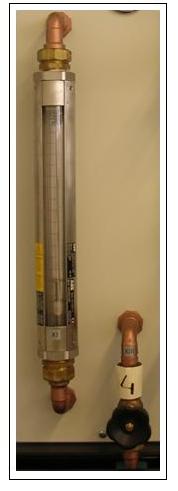
Figure 3.11: Air flow meter.
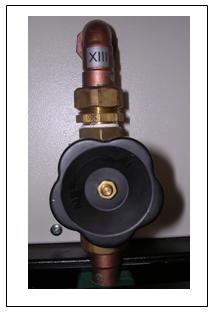
Figure 3.12: Air valve adjustment.
These devices serve to regulate the air flow to be introduced into the column. Before this air is filtered by a filter porosity of a certain size because it captured large particles. Once it picks up air is compressed from the compressor. When the air has been compressed enters into the column. Within the column, at the bottom, there is another filter where serves to retain particles that may have happened, so they can not get inside the column.
Its characteristics are:
- 1 inch.
- Max. 10bars.
- Max. 30°C
FLOW METER AND VALVE ADJUSTMENT OF WATER AND THERMOMETER:
In figure 3.13 shows a water flow meter that is located in the central panel, also has a thermometer and his regulating valve.
There is no universal flow meter for any type of fluid. Depending on their characteristics (if a gas, vapour, if you have solid contents, if toxic, corrosive ...) we select a mesudador.
The main objective of this flow meter is determine what amount of water is working at all times within the column. To regulate it is necessary to turn the valve regulating the flow of water to the right if you want to lower the volume (closed valve) and left if you want to increase the flow (open valve).
The thermometer marks what is the temperature of the water that flows through the column. It is advisable not to work at temperatures above 30-32ºC, as some equipment, the maximum temperature that can work is 30°C.

Figure 3.13: Water flow meter.
Where:
1- Valve adjustment of water.
2- Flow meter water.
3- Thermometer.
The features of rotameter are:
- Flow range of 000 to 600 l/h.
- Working Range 75 to 250 l/h.
The characteristics of the thermometer are:
- Temperature range of 00-60°C
- Working Range 20 to 31ºC
U-SHAPED TUBULAR GAUGES AND TAP REGULATION
These manometers used to measure the relative pressure that exists inside the column.

Figure 3.14: U-shaped tubular gauges.

Figure 3.15: Tap regulation.
The manometer shown in figure 3.14 is a manometer water column, this means that the unit of measure are mmH2O. The two columns are formed by two plastic U-shaped, where the interior of these tubes are distilled water, which is introduced to the top where the taps of regulation (figure 3.15). It should be very clear what connections are correct before starting the device, as a result of pressure that exists inside the column, the water in the U-shaped manometers exit for these faucets and we have to recalibrate.
The calibration of these gauges can be done by opening the taps, which causes a release of pressure and water level decreases. To regain the same amount of water can be made from a syringe attached to a plastic tube the size of the opening of the tap like the one shown in figure 3.16. Once enter the water we return to close the taps and open the device to verify that there is a good connection.
The right connections are:
- Column Base - tap on the right.
- Center - column central tap.
- Top of column - tap the left.
The dp1and dp2 are the pressures differences within the column. dp1 is the pressure difference between the upper and central part of the column. In contrast, dp2 is the pressure difference between the bottom and the middle column.
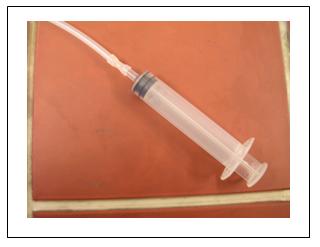
Figure 3.16: Connecting the syringe with rubber tubing.